
 Admin
Admin Introduction: Can Jumping Jacks Really Burn 1000 Calories?
Yes — but let’s be real with you from the start.
Burning 1,000 calories through jumping jacks alone is a serious challenge. It requires dedication, the right strategy, and ideally the right nutritional support. But it is absolutely possible, and thousands of fitness enthusiasts in both the USA and India are using jumping jacks as a cornerstone of their fat-burning routines.
This is not just another “do 500 reps and lose weight” article. This is a deep, research-backed guide that tells you exactly how many jumping jacks it takes to burn 1,000 calories based on your body weight, your pace, and your intensity level. You will also discover how the right supplements from Core Supplements can make every single rep count more.
Let’s break it all down.
What Science Says: The MET Formula Behind Jumping Jack Calorie Burn
Before jumping into the numbers, you need to understand the science. Exercise scientists use a measurement called MET (Metabolic Equivalent of Task) to calculate calorie burn.
The formula is: Calories = MET × Weight (kg) × Time (hours). The MET value for jumping jacks is officially listed at 8 according to the 2024 Adult Compendium of Physical Activities, maintained by researchers at Arizona State University.
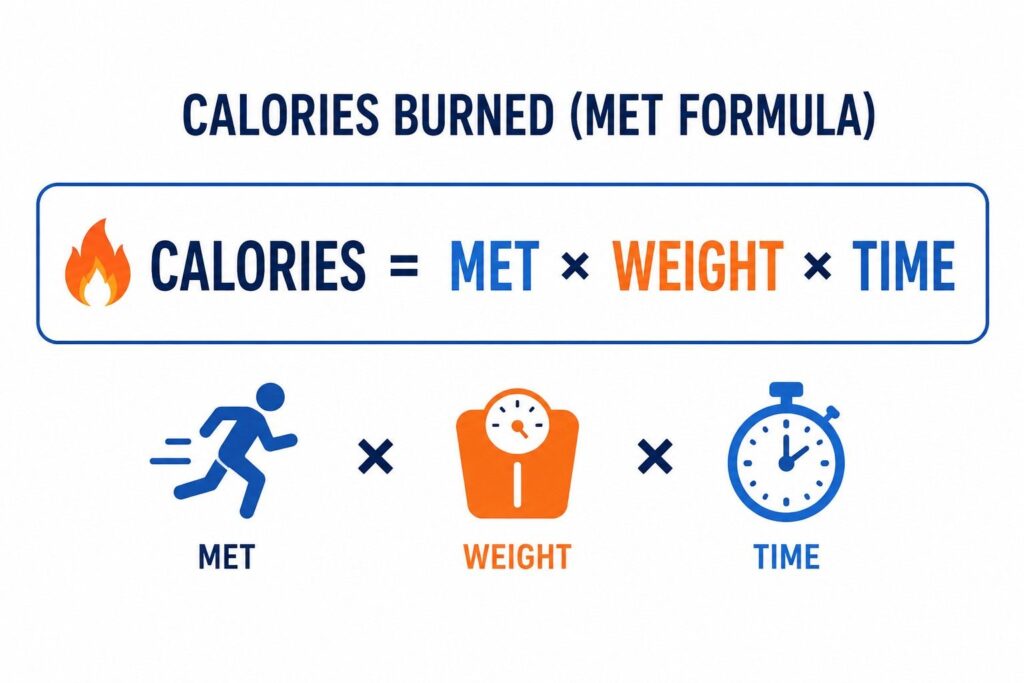
HIIT-style jumping jack variations can push the MET value as high as 12, while standard vigorous jumping jacks fall in the 7.5 to 8 range.
This means two things:
- Your body weight directly determines how many calories you burn per minute.
- Your intensity level can dramatically increase or decrease that number.
How Many Calories Does One Jumping Jack Burn?
Assuming a pace of 25 jumping jacks per minute and an average body weight, one jumping jack burns approximately 0.43 calories, and 100 jumping jacks burn about 43 calories.
At a faster pace of around 50 jumping jacks per minute, each jumping jack burns approximately 0.2 calories, making 100 jumping jacks equal to roughly 20 calories.
The wide range between these two estimates tells you something critical: pace matters enormously. A slow, sloppy set burns far fewer calories than an explosive, full-range set performed with intensity.
7 Key Facts About How Many Jumping Jacks It Takes To Burn 1000 Calories
1. Your Body Weight Is the Single Biggest Variable
This is the number-one factor most people ignore. Heavier individuals burn more calories per jumping jack than lighter ones. A 200-pound person doing the same set as a 130-pound person will burn significantly more calories in the same time.
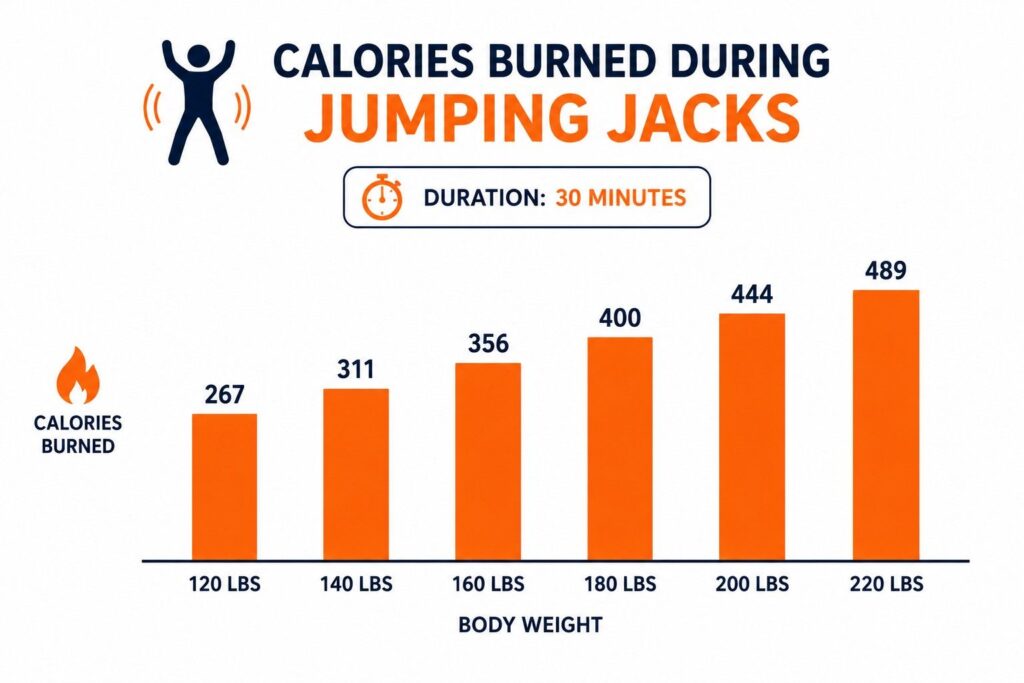
Here is the approximate number of jumping jacks needed to burn 1,000 calories based on body weight at a moderate pace:
| Body Weight | Jumping Jacks Needed | Approximate Time |
|---|---|---|
| 120 lbs (54 kg) | ~7,000–8,000 | 140–160 minutes |
| 150 lbs (68 kg) | ~5,500–6,500 | 110–130 minutes |
| 175 lbs (79 kg) | ~4,500–5,500 | 90–110 minutes |
| 200 lbs (91 kg) | ~4,000–5,000 | 80–100 minutes |
| 220 lbs (100 kg) | ~3,500–4,500 | 70–90 minutes |
These are estimates based on the standard MET formula used by exercise physiologists, which carries an accuracy range of ±15–20% depending on individual fitness level, age, and technique.
2. Your Pace Determines How Long You Need to Exercise
There is a massive difference between doing 25 jumping jacks per minute versus 100 per minute. Here is how pace affects your calorie burn per minute:
At a moderate pace of 30–50 jumping jacks per minute, you burn approximately 8 calories per minute. At a fast pace of 70–100 jumping jacks per minute, you burn roughly 10–12 calories per minute.

Practical math:
- At 8 calories/minute → You need 125 minutes to burn 1,000 calories
- At 10 calories/minute → You need 100 minutes to burn 1,000 calories
- At 12 calories/minute → You need 83 minutes to burn 1,000 calories
Nobody recommends doing 83–125 minutes of non-stop jumping jacks in one session. The smart approach — which we will cover shortly — is to break this across multiple sessions or combine it with other movements.
3. 1000 Reps Will NOT Burn 1000 Calories (A Common Myth Debunked)
This is one of the biggest misconceptions floating around social media. People see “1000 jumping jacks” and assume that equals 1,000 calories burned. That is not even close to accurate.
For a 75 kg person, burning 1,000 calories from jumping jacks alone requires approximately 5,000 jumping jacks — roughly 60 to 65 minutes of continuous effort.
Doing 1,000 jumping jacks at a pace of 25 per minute burns only approximately 430 calories for an average-weight person.
So if someone on Instagram claims 1,000 reps burned 1,000 calories — they are either very heavy, working at elite intensity, or simply not being honest.
4. Intensity Upgrades Can Cut Your Time in Half
Standard jumping jacks are effective. But HIIT-style jumping jack variations can dramatically increase the calorie burn per minute. HIIT protocols using explosive jumping jack variations can push the MET value as high as 12, compared to the standard 7.5–8 MET for regular vigorous jumping jacks.
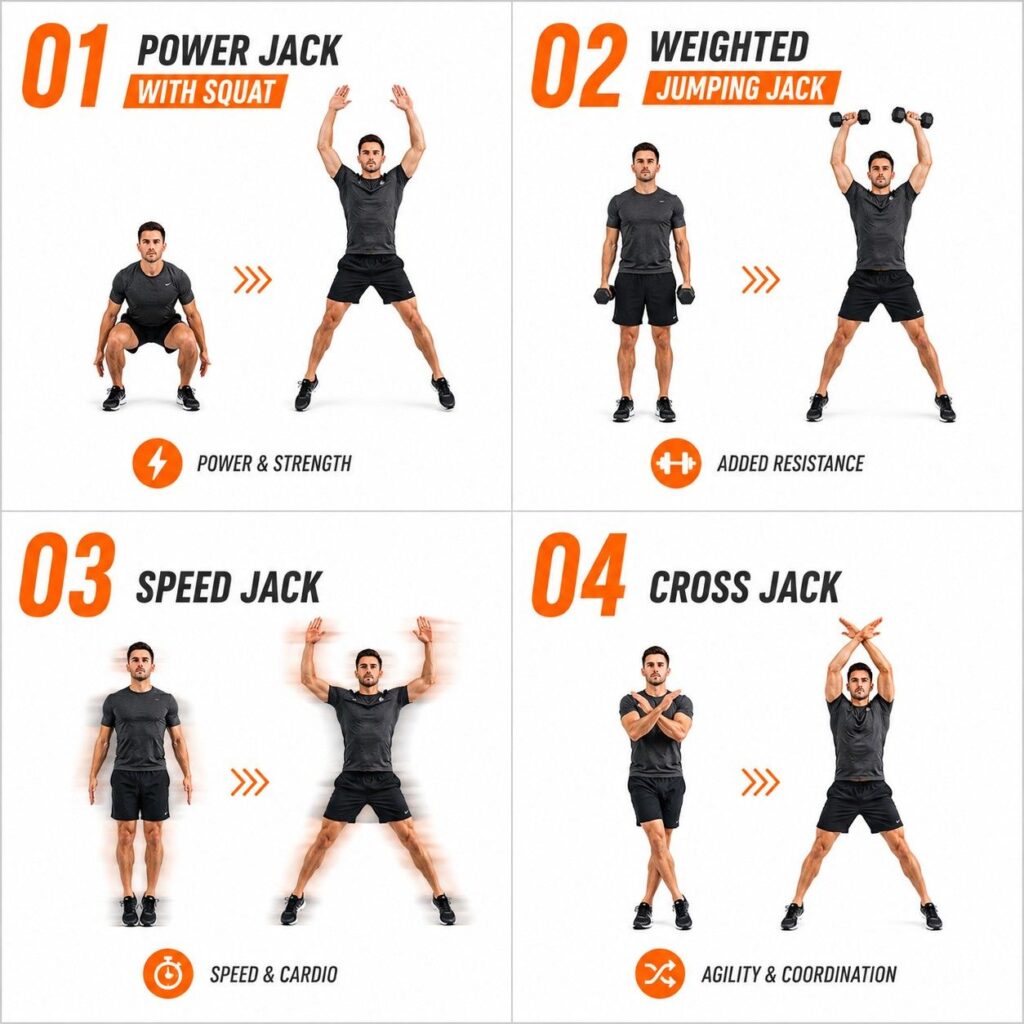
Here are four intensity upgrades that increase calorie burn:
Power Jacks: Wide, explosive squat at the bottom of each rep. Engages glutes and quads heavily. Burns approximately 25–30% more calories than standard jacks.
Weighted Jumping Jacks: Hold 1–3 lb dumbbells or wrist weights. Increases upper body engagement and raises heart rate faster.
Speed Jacks: Maximum cadence for 20–30 second bursts. Burns 40–50% more calories in that window than a steady-state pace.
Cross Jacks: Cross your arms and legs instead of a wide-open position. Adds coordination demand and increases core activation.
5. Breaking It Into Sessions Is the Smarter Strategy
A realistic daily target for most adults is 100 to 500 jumping jacks, depending on fitness level. Trying to burn 1,000 calories in a single jumping jack session is neither practical nor advisable for most people.
A much smarter weekly approach:
Option A – 5-Day Split:
- 5 sessions per week × 200 calories each = 1,000 calories/week
- Requires approximately 1,000–1,200 jumping jacks per session for a 150-lb person
Option B – 3-Day HIIT Format: An effective routine involves 3 to 4 sets of 5-minute intervals of jumping jacks, performed 2 to 3 times per week. This format is easy on the joints while still providing significant calorie burn over time.
Option C – Combined Cardio Approach: 30 minutes of jumping jacks + 30 minutes of brisk walking or cycling. This hybrid approach burns 1,000+ calories while reducing repetitive joint stress from high-rep jumping jack sets.
6. Nutrition and Supplements Play a Critical Role in Hitting 1000 Calories Burned
Here is something no one talks about enough: you can do all the jumping jacks in the world, but if your nutrition and supplementation are off, you will plateau fast.
The right supplement stack does not just support recovery — it actively increases the quality of every session, which means more calories burned per rep.

Pre-Workout Supplements increase your explosive output and keep your pace high throughout the session. When you can maintain 80–100 jacks per minute instead of dropping to 30–40 per minute due to fatigue, you burn significantly more calories in the same time window. Look for pre-workouts with clinically dosed caffeine (150–200 mg), beta-alanine for endurance, and citrulline for blood flow.
Fat Burners with Thermogenic Ingredients raise your resting metabolic rate, meaning you continue burning additional calories even after your jumping jack session ends. Ingredients like green tea extract, L-carnitine, and capsaicin have solid research behind them.
Protein Supplements (Whey or Plant-Based) are essential when doing high-volume cardio. Combining high-intensity cardio with a diet rich in high-quality protein helps preserve muscle mass during calorie-restricted fat-loss phases. Losing muscle while doing cardio is the enemy of long-term fat loss — protein prevents it.
BCAAs (Branched Chain Amino Acids) consumed during long jumping jack sessions reduce muscle breakdown and mental fatigue, allowing you to maintain intensity longer.
For both Indian and USA audiences: look for products that are third-party tested and label-transparent. In India, ensure FSSAI compliance. In the USA, NSF Certified for Sport products offer the highest assurance of quality.
7. Track the 5 Factors That Determine Your Personal Calorie Burn
No two people burn exactly the same number of calories doing jumping jacks. Here are the five variables that determine your personal number:
Body Weight: As established, heavier individuals burn more calories per session. A 200-lb person exercising at vigorous intensity burns roughly 15.1 kcal per minute during jumping jacks.
Age: Younger individuals generally have higher metabolic rates. Calorie burn can decrease by 5–10% per decade as metabolism naturally slows after age 30.
Fitness Level: Trained individuals may burn fewer calories for the same activity because their bodies become more efficient at the movement over time. This is why progressive overload — increasing pace, reps, or intensity over time — is essential.
Gender: Biological males typically burn 5–10% more calories than biological females at the same body weight due to differences in muscle mass percentage.
Range of Motion: Full-range jumping jacks — arms fully extended overhead, feet spread beyond shoulder width — burn significantly more calories than small, lazy reps. Quality of movement matters as much as quantity.
How To Structure a 1000-Calorie Jumping Jack Workout Plan
If your goal is to burn 1,000 calories per week through jumping jacks (a realistic, sustainable target), here is a tested weekly structure:
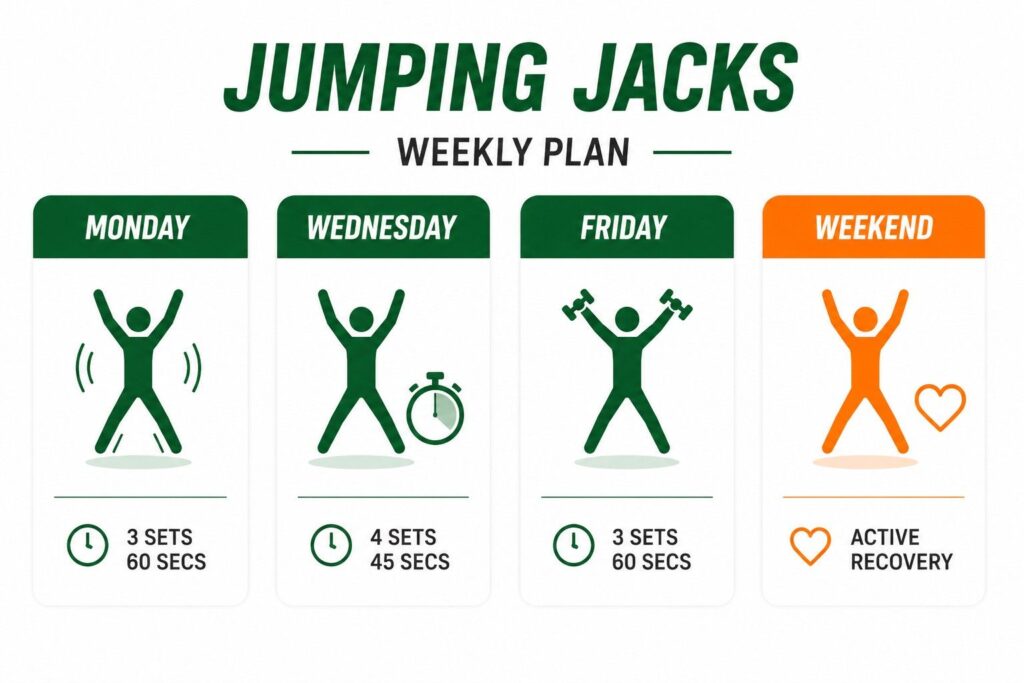
Monday – Power Jack HIIT (30 minutes) Warm-up: 5 minutes light cardio Main: 4 × 5-minute power jack intervals with 60-second rest Cool-down: 5 minutes stretching Estimated burn: 300–400 calories (varies by weight)
Wednesday – Standard Jack Endurance (40 minutes) Warm-up: 5 minutes Main: 30 minutes steady-state jumping jacks at moderate pace Cool-down: 5 minutes Estimated burn: 250–320 calories
Friday – Speed Jack Tabata (25 minutes) Warm-up: 5 minutes Main: 8 rounds of 20 seconds max-speed jacks + 10 seconds rest (Tabata protocol × 3 sets) Cool-down: 5 minutes Estimated burn: 200–280 calories
Weekend – Active Recovery Walk or Light Cycling: 30–45 minutes Estimated burn: 150–200 calories
Weekly Total: 900–1,200 calories depending on body weight and intensity.
Frequently Asked Questions

Q: How many jumping jacks do I need to do to burn 1000 calories in one session?
For a 150-lb (68 kg) person at moderate pace, you would need approximately 5,500–6,500 jumping jacks performed over 110–130 minutes in a single session. This is not recommended for most people. Spreading this across multiple sessions throughout the week is far safer and more sustainable.
Q: How many calories do 500 jumping jacks burn?
To burn 500 calories by doing jumping jacks, you would need approximately 1,163 jumping jacks at a pace of 25 per minute. At 500 reps, a 150-lb person burns roughly 85–100 calories.
Q: Do jumping jacks burn belly fat specifically?
Jumping jacks burn fat throughout the entire body, not just the belly. Spot reduction — burning fat from one specific area — is a fitness myth not supported by research. That said, jumping jacks create a calorie deficit when done consistently, and a calorie deficit is what actually reduces body fat, including abdominal fat.
Q: How many jumping jacks should a beginner do daily?
Start with 100–200 per day split into 2–3 sets. Build by 50 reps per week. Within 4–6 weeks, most beginners can comfortably complete 500+ reps per session with proper form.
Q: Can I lose weight doing jumping jacks alone without changing my diet?
Jumping jacks help create a calorie deficit, but diet controls the majority of fat loss outcomes. For best results, combine jumping jacks with a high-protein diet and the right supplement stack targeting fat oxidation and energy output.
Final Thoughts: The Real Number You Need To Know
The answer to “how many jumping jacks to burn 1000 calories” is not a single number — it is a range that depends on your body weight, intensity, pace, and fitness level. But here is the practical summary:
- Lighter individuals (under 130 lbs / 59 kg): Approximately 7,000–8,000 jumping jacks across multiple sessions
- Average individuals (150–175 lbs / 68–79 kg): Approximately 5,000–6,500 jumping jacks
- Heavier individuals (200+ lbs / 91+ kg): Approximately 4,000–5,000 jumping jacks
The smartest approach is to never try to hit 1,000 calories in a single session. Instead, build a consistent weekly cardio routine, dial in your protein and supplementation, and let the calorie burn compound over time.
Explore Related Guide → https://coresuppliments.com/gym-diet-plan-for-weight-loss-for-male/, https://coresuppliments.com/10-best-detox-waters-to-lose-belly-fat-fast/

 Admin
Admin